

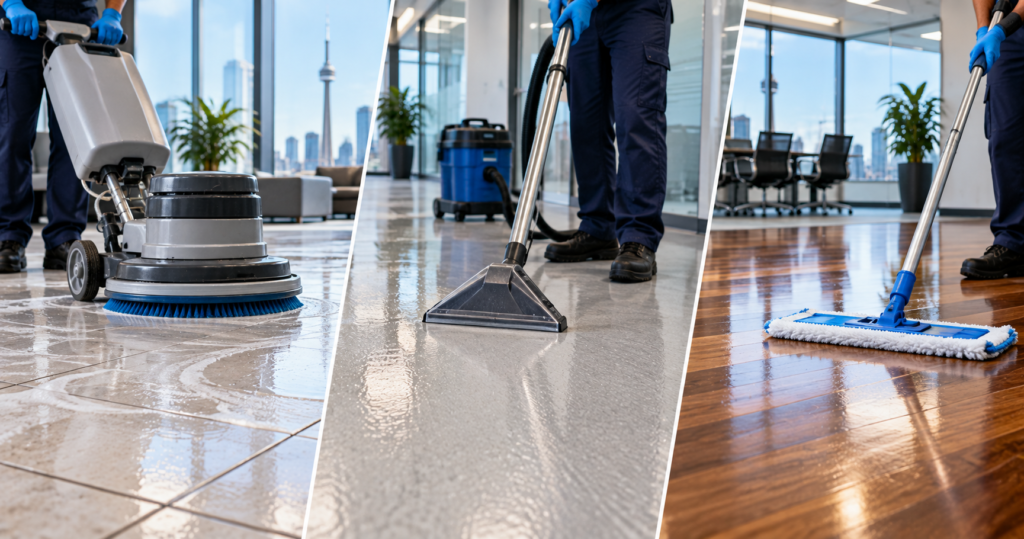
Commercial floor cleaning in Toronto helps businesses remove tracked-in dirt, scuff marks, salt residue, spills, and visible traffic-lane buildup from hard floors such as tile, vinyl, VCT, sealed concrete, terrazzo, and suitable hardwood surfaces. The right cleaning method depends on the floor material, finish condition, level of foot traffic, and whether the space needs routine scrubbing, deeper cleaning, polishing, or other floor-care work.
In offices, retail stores, clinics, showrooms, lobbies, and other commercial spaces, entryways and customer-facing floors often show wear first. As a result, floor care should be planned around business hours, drying time, staff and customer traffic, access rules, and the specific maintenance needs of each surface.
TidyUp HandyCrew provides commercial cleaning services in Toronto for businesses that need practical hard-floor and workplace cleaning support. This guide explains commercial floor cleaning in Toronto, including common floor types, high-traffic problem areas, cleaning methods, maintenance planning, scheduling, and when professional floor care may be useful.
Key Takeaways
- Commercial floor cleaning helps businesses manage traffic lanes, visible dirt, salt tracking, rain tracking, scuff marks, and floor appearance.
- Offices, retail stores, clinics, showrooms, lobbies, hallways, and waiting areas often need hard floor cleaning around business schedules.
- Tile, vinyl, laminate, hardwood, and other hard floors may need different cleaning approaches.
- Toronto businesses may need after-hours access, parking, elevator access, key or fob instructions, and drying-time planning.
- Grout detail, scuff review, carpet cleaning, post-renovation dust, or specialty floor care may require add-ons.
- A checklist helps managers request a more accurate quote.
What Is Commercial Floor Cleaning?
Commercial floor cleaning is a professional cleaning service for hard floors in business spaces such as offices, retail stores, showrooms, clinics, lobbies, hallways, and commercial units. It focuses on traffic lanes, visible dirt, entryway buildup, floor edges, scuff-prone areas, and cleaning schedules that work around business operations.
This service is different from commercial carpet cleaning. It focuses on hard surfaces, such as tile, vinyl, laminate, hardwood where appropriate, concrete, and other non-carpet commercial floors.
It can support office reception areas, retail aisles, clinic waiting rooms, showroom display paths, building lobbies, staff areas, and high-traffic commercial hallways.
What Is Included in Commercial Floor Cleaning?
Commercial floor cleaning usually includes floor condition review, visible dirt removal, cleaning based on floor type, traffic lane attention, entryway floor care, floor edge cleaning where accessible, and drying-time planning. Grout detail, scuff treatment, carpet cleaning, specialty floor care, or restoration may need add-ons or separate assessment.
Common areas include:
- Office hard floors, Retail hard floors
- Clinic floors, Showroom floors
- Reception floors, Lobby floors
- Hallways, Waiting areas
- Tile floors, Vinyl floors
- Laminate floors
- Hardwood floors where appropriate
- Traffic lanes, Entryways
- Floor edges where accessible
- Scuff-prone areas, Drying-time planning
- After-hours scheduling
For broader business cleaning planning, read the commercial cleaning Toronto business guide.
Commercial Floor Cleaning Checklist
A commercial floor cleaning checklist helps managers identify floor types, traffic lanes, scuffs, access needs, and add-ons before requesting a quote.
Office Floor Areas
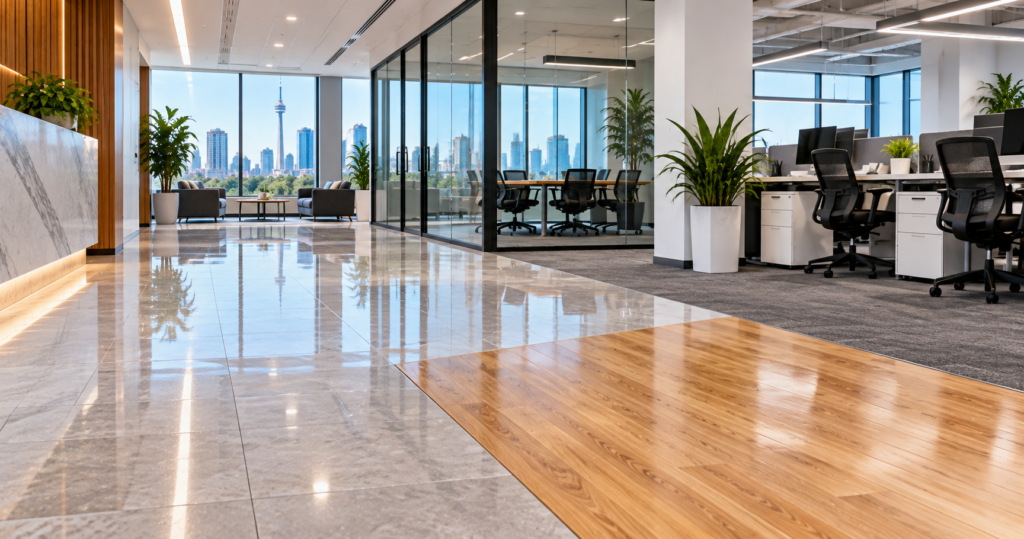
Office floors often show buildup near reception areas, hallways, staff rooms, and meeting rooms. These areas need practical cleaning around work schedules.
Check:
- Reception floor
- Desk-area floor where accessible
- Hallways
- Meeting rooms
- Boardrooms
- Staff rooms if included
- Entry mats
- Traffic lanes
- Floor edges
- Baseboard areas where included
If the office also needs a full workspace reset, the office deep cleaning Toronto guide can help compare scope.
Retail and Showroom Floor Areas
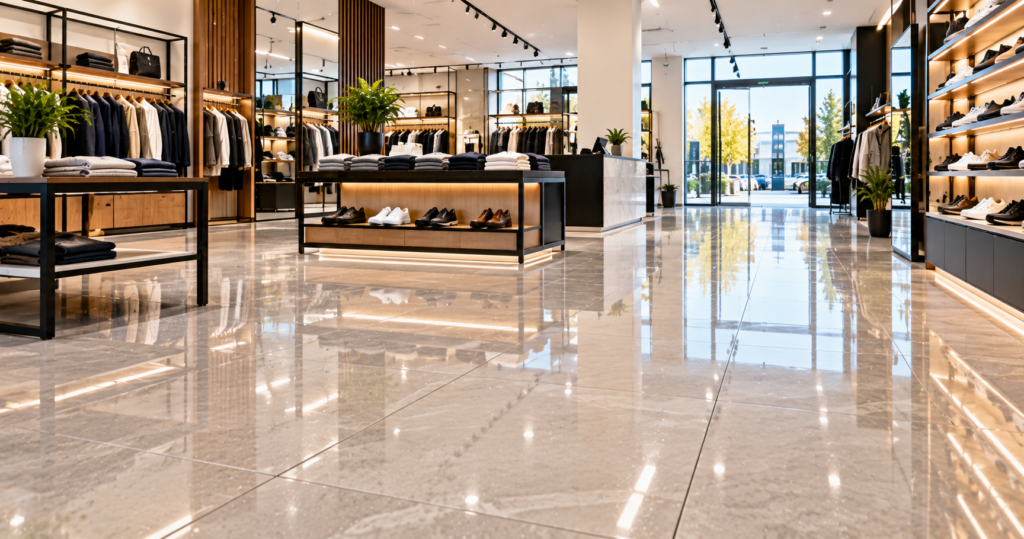
Retail and showroom floors need extra attention because customers move through these areas throughout the day.
Review:
- Customer aisles
- Checkout area floor
- Fitting room floor if applicable
- Waiting or seating areas
- Display paths
- Entryway floor
- Product traffic zones
- Floor near counters
- Floor edges
- Visible spill areas
For retail-specific cleaning needs, see the retail store cleaning Toronto checklist. For display-focused spaces, the showroom cleaning Toronto guide is also relevant.
Clinic and Waiting Room Floors
Clinic and waiting room floors should be planned around appointments, staff flow, and after-hours access.
Include:
- Reception floor
- Waiting room floor
- Hallway traffic lanes
- Entryway dirt
- Washroom floor if included
- Staff area floor if included
- Floor edges
- Mats
- High-traffic paths
- Areas needing staged cleaning
Avoid making health, sanitization, or compliance claims unless specialist services are separately scoped.
Entryways, Lobbies and Traffic Lanes
Entryways and traffic lanes usually show dirt first because they carry the most foot traffic.
Focus on:
- Main entrance floor
- Lobby floor
- Elevator lobby floor if included
- Hallway traffic lanes
- Rain or salt tracking areas
- Walk-off mat zones
- Doorway floor edges
- High-foot-traffic paths
- Visible dirt lines
- Scuff-prone zones
These areas may need more frequent cleaning than low-traffic rooms.
Tile, Vinyl, Laminate and Hardwood Areas
Different commercial floor types need different care. Floor condition, coating, age, and manufacturer guidance should be reviewed before cleaning.
Check:
- Tile floor condition
- Grout lines if relevant
- Vinyl floor surface
- Laminate caution
- Hardwood floor caution
- Specialty coating notes
- Manufacturer care instructions if available
- Avoid excessive water claims
- Separate assessment where needed
For related floor-care context, read how to clean hardwood floors,how to clean grout, and the pH-neutral floor cleaner guide.
What Businesses Often Miss Before Floor Cleaning
Businesses often notice visible floor dirt but forget access, drying time, floor type, and furniture movement.
Common missed details include:
- Not identifying traffic lanes,mentioning scuff marks, clearing small furniture
- Forgetting after-hours access
- Not planning drying time
- Forgetting elevator or loading access
- Not securing documents or electronics
- Not checking floor type, mentioning grout or edge buildup,sharing photos
- Assuming all scuffs can be removed,carpet cleaning is included & every floor can be cleaned the same way
These details help the quote match the real floor condition.
Toronto Business Access and Scheduling
Toronto commercial floor cleaning often works best after hours, early morning, or on weekends. Scheduling helps reduce disruption and gives floors time to dry before staff, patients, clients, or customers return.
Before booking, confirm:
- After-hours access
- Early-morning cleaning
- Weekend scheduling
- Parking
- Loading access
- Elevator access
- Security instructions
- Key, fob, or lockbox details
- Unit or suite access
- Mall or plaza rules
- Building rules
- Property manager coordination
- Drying-time planning
- Staff and customer traffic timing
- Staged cleaning for larger spaces
Larger spaces may need staged cleaning so part of the property remains usable.
Commercial Floor Cleaning vs Commercial Carpet Cleaning
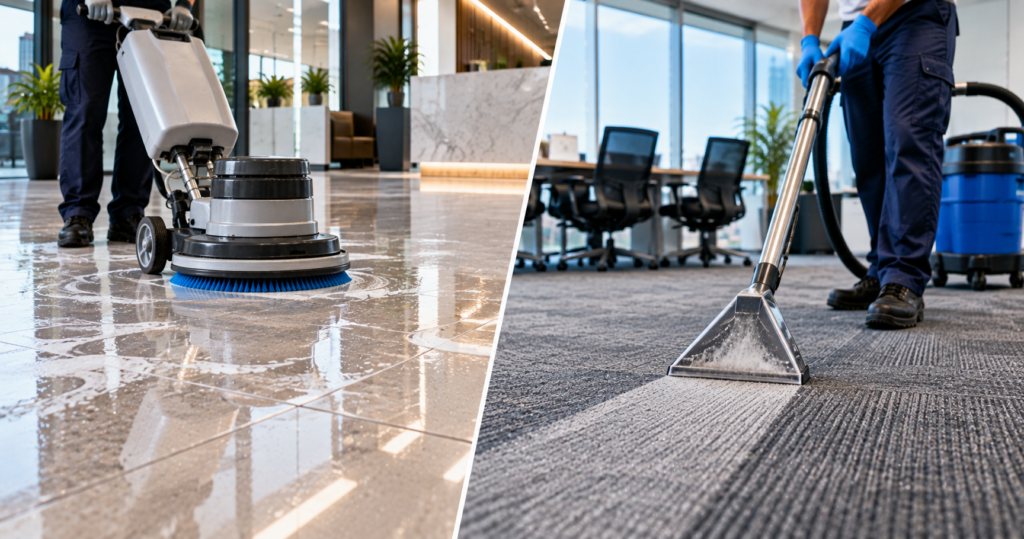
Commercial floor cleaning and commercial carpet cleaning are both floor-care services, but they handle different surfaces and concerns.
| Service | Best For | Main Goal | Floor-Specific Focus | Best Time |
| Commercial floor cleaning | Hard floors in business spaces | Manage visible dirt and scuffs | Tile, vinyl, laminate, hardwood, entryways | After hours or staged |
| Commercial carpet cleaning | Carpeted business areas | Manage traffic lanes and stains | Carpet, carpet tiles, entry mats | After hours or weekends |
| Office deep cleaning | Offices with buildup | Reset workspace areas | Desks, floors, kitchens, washrooms | Periodic or seasonal |
| Retail store cleaning | Shops and boutiques | Keep store areas clean | Sales floors, fitting rooms, checkout areas | Daily, weekly, or after hours |
| General commercial cleaning | Business spaces | Maintain overall property | Floors, bins, washrooms, shared areas | Recurring or one-time |
If your space also has carpeted areas, review the commercial carpet cleaning Toronto guide before booking.
When Should Businesses Book Commercial Floor Cleaning?
Businesses should book commercial floor cleaning when hard floors look dull, marked, sticky, uneven, or visibly dirty in high-traffic areas.
Good times to book include:
- Before client visits,reopening
- After heavy foot traffic, winter salt and rain tracking
- After spills or visible floor marks
- Before seasonal sales or events, tenant handoff
- Before starting recurring commercial cleaning
- When floors look dull, marked, sticky, or uneven in high-traffic areas
After renovations, hard floor cleaning may need to be paired with dust-focused service. The post-renovation dust cleaning Toronto guide can help with planning.
When Add-Ons May Be Needed
Some floor-related tasks need extra time, tools, or separate specialist assessment.
Possible add-ons include:
- Grout detail cleaning
- Scuff review
- Carpet cleaning
- Commercial carpet cleaning
- Upholstery cleaning
- Floor care
- Post-renovation dust cleaning
- High dust detail
- Window track detail cleaning
- Junk removal
- Severe odour assessment
- Pest-related cleaning
- Mould remediation
- Floor repair, refinishing, stripping, waxing, polishing, or replacement as separate specialist work if not included in scope
- Specialty floor care if manufacturer instructions are provided
Add-ons should be discussed before booking so the quote reflects the real scope.
How to Prepare Before Cleaners Arrive
Preparation helps floor cleaning run smoothly and protects business items.
Use these steps:
- Confirm business address, unit number, and access instructions.
- Share parking, loading, elevator, security, key, fob, or lockbox details.
- Confirm whether floor cleaning should happen after hours or before opening.
- Identify floor types, traffic lanes, entryways, and priority rooms.
- Move small items, loose boxes, and floor clutter where possible.
- Secure documents, electronics, valuables, and sensitive equipment.
- Mention scuffs, spills, sticky spots, grout concerns, or delicate flooring.
- Confirm furniture movement expectations before the appointment.
- Share photos of problem areas if helpful.
- Plan drying time before staff or customers return.
- Confirm quote scope, add-ons, and deadline.
This is especially important for property-managed spaces, mall stores, clinics, and high-rise offices.
How Long Does Commercial Floor Cleaning Take?
Commercial floor cleaning time depends on floor area, floor type, floor layout, furniture, traffic level, buildup, access, business hours, cleaning scope, drying-time needs, and add-ons.
General estimates include:
- Small office or retail hard floor area: 2–4 hours
- Small to medium business floor area: 4–8 hours
- Larger office, retail, clinic, or showroom space: 8–12+ hours
- Heavy traffic lanes, scuffs, buildup, or add-ons: may need extra time
- After-hours or staged cleaning: depends on access and business schedule
A clear floor plan, photos, and priority list can help the cleaning team estimate time more accurately.
How Long Do Floors Take to Dry After Cleaning?
Floor drying time depends on floor type, cleaning method, ventilation, humidity, room temperature, traffic level, and how much moisture is used during cleaning. Businesses should plan extra time before staff, customers, carts, chairs, or rolling equipment return to cleaned areas.
There is no guaranteed drying time for every floor. Ask for drying-time expectations based on the floor type, method, room conditions, and cleaning scope.
After-hours or weekend cleaning can help reduce disruption.
How Much Does Commercial Floor Cleaning Cost?
Commercial floor cleaning cost depends on square footage, room count, floor type, traffic lane condition, scuff or spill level, access, after-hours timing, furniture expectations, and add-ons.
Cost factors include:
- Floor square footage
- Number of rooms
- Floor type
- Traffic lane condition
- Scuff or spill level
- Grout or edge buildup
- Furniture movement expectations
- Access and parking
- Elevator or loading needs
- After-hours scheduling
- Urgency
- Add-ons
- One-time vs recurring cleaning
For broader business cleaning price context, read how much are office cleaning services.
Common Commercial Floor Cleaning Mistakes
Commercial floor cleaning works best when managers define floor type, access, traffic lanes, add-ons, and drying-time needs before service.
Avoid these mistakes:
- Waiting until traffic lanes become very visible
- Not planning drying time, arranging after-hours access
- Forgetting key, fob, or security instructions
- Not clearing floor clutter,securing electronics or documents
- Assuming all scuffs can be removed, carpet cleaning is included, floor restoration is included
- Not mentioning floor type or specialty coating,sharing photos of heavy buildup
- Choosing only by price
- Not planning recurring floor care after a reset
Instead, prepare access details, photos, and floor-type information before requesting a quote.
Final Checklist Before Booking
Before requesting a commercial floor cleaning quote, prepare the main details.
Use this checklist:
- Confirm business name, address and unit, floor square footage or room count
- Mention business type, office, retail, showroom, clinic, lobby, or hallway areas
- Identify floor type,traffic lanes, scuffs, spills, or sticky spots
- Mention grout, delicate flooring, or specialty coatings,furniture movement expectations
- Share access, key, fob, elevator, loading, and parking details
- Confirm after-hours or weekend needs
- Plan drying time
- Ask about add-ons
- Share photos
- Request quote details
These details help TidyUp HandyCrew recommend a more accurate commercial floor cleaning scope.
FAQs About Commercial Floor Cleaning in Toronto
1. What is included in commercial floor cleaning?
Commercial floor cleaning usually includes floor condition review, visible dirt removal, floor-type-based cleaning, traffic lane attention, entryway floor care, floor edge cleaning where accessible, and drying-time planning. Grout detail, scuff treatment, carpet cleaning, specialty floor care, or restoration may need add-ons.
2. Is commercial floor cleaning different from commercial carpet cleaning?
Yes. Commercial floor cleaning focuses on hard floors such as tile, vinyl, laminate, hardwood, concrete, and other non-carpet surfaces. Commercial carpet cleaning focuses on carpets, carpet tiles, traffic lanes, entry mats, and carpet drying-time planning.
3. Can commercial floor cleaning happen after hours?
Yes. Commercial floor cleaning can often happen after hours, early morning, or on weekends, depending on access, parking, elevator use, keys, fobs, building rules, security instructions, and drying-time needs.
4. How often should commercial floors be cleaned?
Commercial floor cleaning frequency depends on foot traffic, floor type, weather tracking, entryway dirt, spills, scuff marks, customer visits, and business use. High-traffic areas may need more frequent attention than low-use rooms.
5. How long does commercial floor cleaning take?
A small office or retail hard floor area may take 2–4 hours. A small to medium business floor area may take 4–8 hours. Larger spaces, heavy buildup, scuffs, or add-ons may need 8–12+ hours or staged cleaning.
6. How much does commercial floor cleaning cost in Toronto?
Cost depends on floor square footage, room count, floor type, traffic lane condition, scuff or spill level, grout or edge buildup, access, parking, elevator use, after-hours scheduling, urgency, add-ons, and whether cleaning is one-time or recurring.
Book Commercial Floor Cleaning in Toronto
Commercial floor cleaning in Toronto helps offices, retail stores, clinics, showrooms, lobbies, and other commercial spaces maintain cleaner, more presentable hard floors in high-traffic areas. The right service can address tracked-in dirt, scuff marks, entryway buildup, traffic lanes, and day-to-day wear while working around business schedules and access requirements.
TidyUp HandyCrew supports Toronto office managers, retail teams, property managers, showroom operators, clinic managers, and commercial tenants with practical hard-floor cleaning for tile, vinyl, laminate, suitable hardwood surfaces, hallways, waiting areas, lobbies, and other customer-facing spaces.
Ready to refresh your business floors? Book commercial floor cleaning services in Toronto, request a commercial floor cleaning quote, or view TidyUp HandyCrew on Google Maps to see our Scarborough location.
