

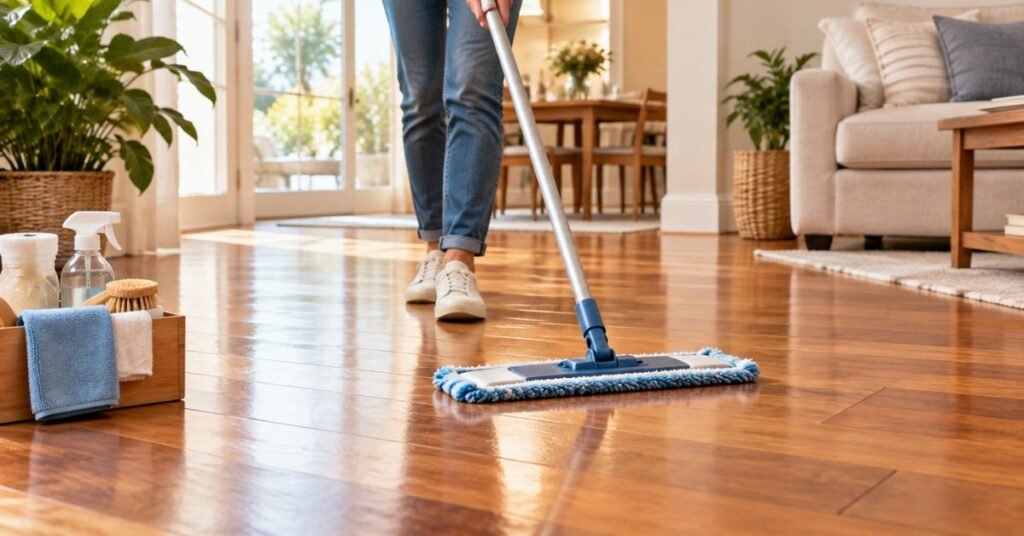
To clean hardwood floors safely, remove loose dust and grit first, then use a barely damp microfiber mop with a cleaner approved for your floor’s finish. Avoid standing water, steam, abrasive pads, and products the flooring manufacturer does not recommend. Always wipe spills quickly and let the floor dry fully.
The finish matters as much as the wood itself. The National Wood Flooring Association’s 2025 guidance advises against steam cleaners, vinegar, excessive moisture, and traditional wet mop-and-bucket cleaning on wood floors. It also recommends maintaining indoor relative humidity around 30% to 50% unless the flooring manufacturer specifies otherwise.
This guide is for homeowners, condo residents, renters, and property managers who want to clean finished hardwood without unnecessary damage. TidyUp HandyCrew also provides professional tile and floor cleaning services in Toronto when routine floor care is no longer enough.
Key Takeaways
- Remove grit before introducing moisture.
- Check the flooring manufacturer’s care instructions first.
- Use a soft microfiber mop and minimal moisture.
- Choose a cleaner approved for finished hardwood.
- Avoid steam, standing water, abrasive pads, and harsh chemicals.
- Blot spills promptly instead of letting liquid sit.
- Treat polyurethane, waxed, oiled, and specialty finishes differently.
- Keep Toronto winter salt and wet footwear away from hardwood where possible.
What You Need
The safest hardwood cleaning routine uses simple tools rather than aggressive equipment. Start with items that remove grit without scratching and let you control moisture carefully.
Prepare:
- Microfiber dust mop or soft-bristle broom
- Vacuum with a hard-floor attachment
- Flat microfiber mop
- Clean microfiber cloths
- Cleaner approved for your hardwood finish
- Dry towel for spills or excess moisture
- Manufacturer’s care instructions, when available
If you are choosing a cleaner, our guide to pH neutral floor cleaners explains why cleaner chemistry matters across hardwood, laminate, vinyl, tile, and stone.
How to Clean Hardwood Floors Safely
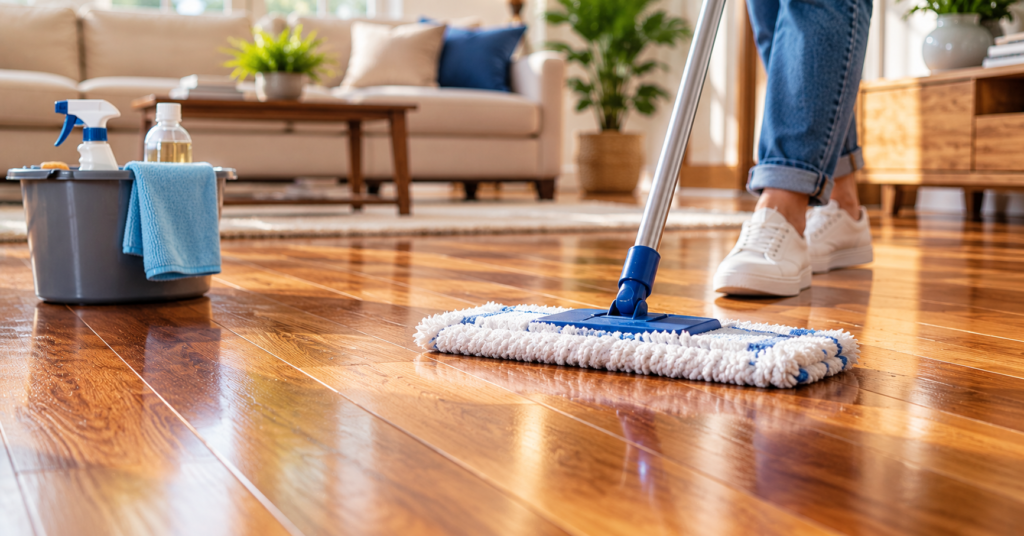
The best way to clean hardwood floors is to work dry first and use minimal moisture second. This removes abrasive debris before mopping and reduces the chance of water sitting in plank seams.
1. Check the Floor Finish
Before cleaning, identify the flooring type and follow the manufacturer’s instructions.
Many modern hardwood floors use a surface finish, but older floors may be waxed, oiled, or treated differently. A product designed for one finish may leave residue or cause problems on another.
If you cannot identify the finish, avoid experimenting with strong homemade cleaners. Use the least aggressive method until you can confirm the correct care instructions.
2. Remove Dust and Grit
Vacuum, sweep, or dry-mop the entire floor before adding cleaner.
Small pieces of sand and grit can scratch the finish when dragged under a damp mop. Pay extra attention to entrances, hallways, dining areas, and other high-traffic zones.
If using a vacuum, choose a hard-floor attachment or setting. Avoid a rotating brush that could mark sensitive flooring.
Cornell Cooperative Extension also recommends regular sweeping and vacuuming with a soft-floor attachment as basic hardwood maintenance.
3. Spot-Clean Spills First
Fresh spills should be blotted promptly with a soft, slightly damp cloth and then dried.
Do not spread a small spill across the floor with a large wet mop. Work from the outside of the spill toward the centre and use only as much moisture as needed.
Sticky residue may need a cleaner specifically approved for your finish.
4. Apply Wood-Safe Cleaner
Follow the product label and flooring manufacturer’s directions.
For many finished hardwood floors, a pH-neutral or manufacturer-approved wood-floor cleaner is a practical option. Apply only the recommended amount.
More cleaner does not always mean a cleaner floor. Excess product can leave streaks or residue.
5. Mop With Minimal Moisture
Use a flat microfiber mop that is damp, not wet.
Work in small sections and avoid leaving puddles behind. If water collects between boards or stays visible on the surface, the mop is too wet.
The National Wood Flooring Association warns that standing water can contribute to cracking, splitting, cupping, warping, finish degradation, and discoloration.
6. Let the Floor Dry
Allow the hardwood to dry completely before replacing rugs or allowing heavy traffic.
If any area remains visibly wet, use a clean dry microfiber cloth. Do not place a rug over a damp section because it can slow evaporation.
What Should You Avoid?
Avoid methods that introduce excessive moisture, heat, abrasion, or incompatible chemicals. The manufacturer’s instructions should always take priority over generic cleaning advice.
| Product or Method | Use on Hardwood? | Why |
| Microfiber dust mop | Usually yes | Removes loose grit gently |
| Hard-floor vacuum | Usually yes | Removes dust without wetting |
| Approved hardwood cleaner | Yes, if compatible | Designed for the finish |
| Barely damp microfiber mop | Usually yes | Limits moisture exposure |
| Wet mop and bucket | Avoid | Can leave excess water |
| Steam mop | Avoid unless manufacturer explicitly approves | Heat and moisture can affect wood and finishes |
| Vinegar | NWFA advises against it | Acid may degrade some finishes |
| Abrasive scrub pad | Avoid | May scratch or dull the finish |
| Oil soap or wax | Finish-dependent | Can leave residue or conflict with some finishes |
| “Shine” or restoration products | Check first | May add an unwanted film |
The 2025 National Wood Flooring Association guidelines specifically advise against vinegar and steam cleaning on wood floors and recommend following finish-manufacturer instructions.
Can You Use Vinegar on Hardwood Floors?
The safest general answer is to avoid vinegar unless your flooring manufacturer specifically approves it.
Advice online varies because hardwood floors use different finishes. However, current National Wood Flooring Association technical guidance advises against vinegar because its acidity can degrade wood-floor finishes.
If your goal is to avoid harsh cleaners, use a product specifically labelled for your flooring and finish instead of relying on a homemade mixture.
How to Remove Spots and Scuffs
Spot cleaning should use the least aggressive method that solves the problem. Start with a soft cloth and the floor manufacturer’s recommended cleaner.
For common issues:
- Food or sticky marks: apply approved cleaner to a cloth and wipe gently.
- Water droplets: blot immediately and dry the area.
- Light scuffs: use a manufacturer-approved hardwood cleaner on a soft cloth.
- Tracked dirt: vacuum first, then damp-clean the remaining mark.
- Unknown stains: avoid scrubbing aggressively or applying solvents without checking the finish.
Do not use steel wool, abrasive powders, bleach, or strong degreasers on a finished hardwood floor unless the manufacturer explicitly permits them.
For whole-home floor care planning, TidyUp’s Toronto house cleaning checklist can help identify other high-traffic areas that need regular attention.
How Often Should You Clean?
Clean hardwood based on traffic and visible soil rather than following one rigid schedule. Busy entrances and kitchens usually need dry cleaning more often than bedrooms.
A practical routine is:
- Remove visible grit and debris as needed.
- Vacuum or dry-mop high-traffic areas regularly.
- Blot spills immediately.
- Damp-clean when the surface looks dirty or develops residue.
- Check furniture pads and entrance mats periodically.
Homes with children, pets, heavy foot traffic, or outdoor entryways may need more frequent maintenance.
The goal is not constant wet cleaning. Preventing grit and moisture from building up often protects the finish better than aggressive deep cleaning.
Hardwood Floor Care in Toronto
Toronto hardwood floors face extra seasonal challenges from winter salt, wet footwear, grit, heating, and changing indoor humidity. Entryway prevention is especially useful because salt and abrasive particles can be tracked across hardwood from sidewalks, parking areas, and condo entrances.
Use absorbent mats near exterior doors and remove wet shoes where practical. Vacuum tracked grit before damp-cleaning it.
Indoor conditions matter too. Wood exchanges moisture with surrounding air. NWFA guidance recommends maintaining roughly 30% to 50% relative humidity year-round, unless your flooring manufacturer specifies another range.
When Professional Cleaning Helps
Professional floor cleaning may make sense when normal vacuuming and finish-safe mopping no longer remove visible residue or widespread soil.
It may also be useful when:
- Large areas need detailed cleaning
- You are unsure which method suits the floor
- Dirt is concentrated in high-traffic areas
- The floor is part of a move-in or move-out clean
- Several flooring materials need different care
- You want to avoid over-wetting sensitive surfaces
TidyUp HandyCrew provides professional tile and floor cleaning in Toronto for hardwood, tile, laminate, and other hard-floor surfaces using methods matched to the material.
How to Keep Hardwood Floors Cleaner Longer
Prevention reduces how often hardwood needs deeper cleaning.
Use mats at entrances, remove grit before it spreads, and wipe liquid spills quickly. Add felt or suitable floor protectors under chairs and furniture.
Avoid dragging heavy furniture across the floor. Also check floor protectors periodically because trapped grit underneath them can scratch the surface.
If the rest of the home also needs detailed attention, see TidyUp’s guide to deep cleaning vs regular cleaning before choosing a cleaning scope.
FAQs About Cleaning Hardwood Floors
What is the best way to clean hardwood floors?
The best method is to vacuum or dry-mop first, then use a barely damp microfiber mop with a cleaner approved for the hardwood finish. Avoid leaving standing water and dry any overly wet spots promptly.
Can you mop hardwood floors?
Yes, many finished hardwood floors can be damp-mopped. The mop should be only slightly damp, not soaking wet. Always check the flooring manufacturer’s instructions first.
Can you use vinegar on hardwood floors?
The National Wood Flooring Association advises against vinegar on wood-floor finishes because vinegar is acidic. Follow the flooring or finish manufacturer’s care instructions instead.
Are steam mops safe for hardwood floors?
NWFA guidance advises against steam cleaners on wood flooring. Heat and moisture can penetrate the flooring and affect the wood or finish. Only use steam if the specific flooring manufacturer explicitly approves it.
What cleaner is safest for hardwood?
Use a cleaner specifically approved for your hardwood flooring and finish. A pH-neutral wood-floor cleaner is often suitable for finished hardwood, but manufacturer instructions take priority.
How do you clean hardwood floors without streaks?
Remove dust first, use only the recommended amount of cleaner, and work with a clean microfiber pad. Too much product or moisture can leave residue and streaking.
How do you clean engineered hardwood?
Engineered hardwood should be cleaned according to its manufacturer’s instructions. Many products use factory-applied finishes and tolerate gentle dry cleaning and minimal damp cleaning, but requirements vary.
When should hardwood floors be professionally cleaned?
Consider professional cleaning when routine vacuuming and approved damp cleaning no longer remove widespread soil, residue, or high-traffic buildup. Physical damage usually requires repair or refinishing rather than cleaning.
Need Help With Hardwood Floor Cleaning in Toronto?
To clean hardwood floors without damaging the finish, remove dry grit first, use a manufacturer-approved cleaner, mop with minimal moisture, and dry any remaining wet areas. Avoid steam, standing water, abrasive tools, and products that are not compatible with the floor finish.
The safest approach is finish-specific rather than product-specific. When in doubt, check the flooring manufacturer’s care instructions before testing a new cleaner or cleaning method.
TidyUp HandyCrew provides floor cleaning support for Toronto houses, condos, apartments, and rental properties. The cleaning approach should match the flooring material, condition, finish, and manufacturer requirements.
For a detailed floor reset, explore tile and floor cleaning services in Toronto or request a cleaning quote.
